01 · The work behind the worship
A living institution, through every age.
Since 1010 CE, Brihadisvara has been sustained by generations of care, service and stewardship.

A calmer way to care for every temple
Devotees, sevas, panchangam, annadhanam, cashbook, banking, finance and assets — managed from one integrated platform.
Overview
ARAM ERP is one integrated platform for the office side of temple life.
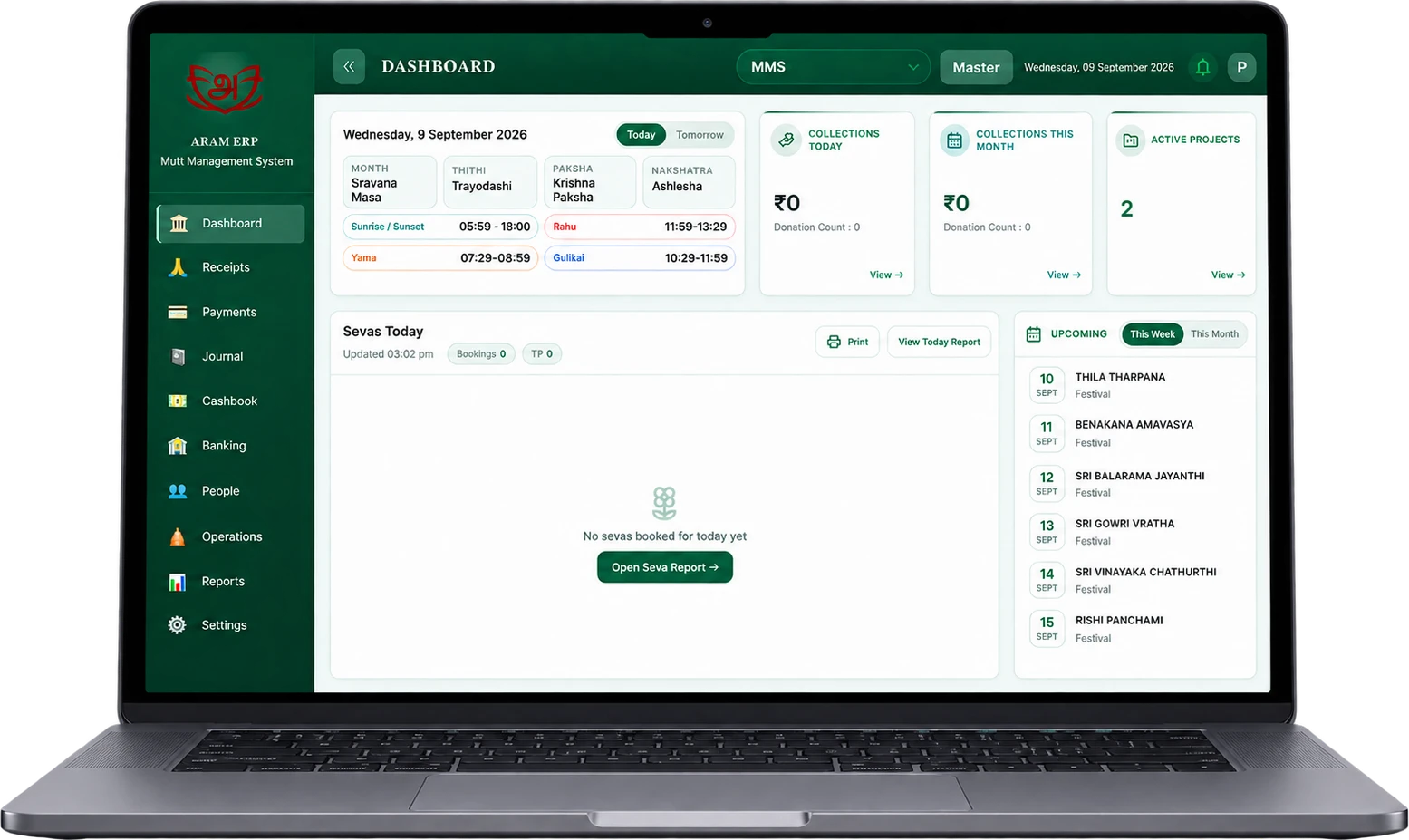
Records in syncOne trusted view
Before & after
The platform
Each module carries its own work and connects to the rest. Choose one to see what it covers.
Daily receipts and payments, cash balances, denomination counting, variance tracking and day closure.
Works with Devotees · Sevas · Annadhanam · Banking · Finance
Features
Devotees & sevas
A devotee books a seva, sponsors annadhanam or makes a donation — recorded against their profile and history.
Sevas & cashbook
A receipt is issued for the booking or donation as it is received.
Cashbook
The day’s receipts and payments are counted by denomination, balanced and closed.
Banking
Deposits, cheques and UPI references are recorded and reconciled with the bank.
Reports
Collections flow into cash flow, project and category-wise reports for trustees.
How we work
We start with how your office works today — donations, sevas, cash, banking and reports.
ARAM ERP is configured around your temple: your sevas, accounts, bank accounts and staff roles.
Office staff, priests, trustees and administrators each learn the part their role uses.
Your team runs the day in ARAM ERP, with our team there to help as you settle in.
Reviews
Daily collections, sevas, and reports are clear at a glance now. What used to take a full day of reconciliation takes minutes.
Before1 dayWith ARAM ERPMinutes
Questions
Something not covered here? Write to us and we will answer it in your walkthrough.
Devotees, sevas, panchangam, annadhanam, cashbook, banking, finance, projects and events, assets and reports — one integrated platform for the administrative work of a temple, on a single foundation of security and governance.
Office staff, priests, trustees and administrators. Each person gets role-based permissions, so they see and change only what their role needs.
Yes. Seva bookings, schedules and receipts feed a clear, priest-facing seva report for the day, so the people performing the service know exactly what is booked.
The cashbook records the day’s receipts and payments, supports denomination counting, tracks any variance and closes the day — so the books match the cash in hand.
The banking module records deposits and withdrawals, follows each cheque through its lifecycle, keeps UPI references and reconciles them against your bank accounts.
Panchangam is built in — tithi, nakshatra, festivals and the ritual calendar — so sevas, festivals and events can be planned around it.
Trial balance, profit and loss, balance sheet and cash flow, along with project-wise and category-wise reports — ready when the committee meets.
Role-based permissions, multi-factor authentication, activity and audit logs, and backups with restore.
Tell us how your office handles donations, payments, banking, people and reports today using the form below. We will plan a walkthrough around the questions your team actually carries.
Contact
Tell us how your office handles donations, payments, banking and reports today. We’ll shape the walkthrough around your questions.